
Earlier this year, I applied for a small grant through the Strother School of Radical Attention (SoRA) and was accepted! Here’s a snip-it of the proposal and a hint of some work to come. It’s very different than the stuff I’d been posting about before on here, but I’m excited to share more about my journey into analogue photography and historical methodology. I’ve long wanted to write a book on analogue science and procure old instruments to try out on my own, so this is a very, very first step into potentially diving into that project since cyanotypes are fairly accessible.
~~
Photographs capture time and light. They preserve a moment on film, paper, or pixels, capturing the realness, the essence, and the emotions of the world around us. In this digital age, most people have a high powered camera in their pockets at all time. It’s all too easy to snap a pic and post it on the web for all to see, archived in seemingly endless perpetuity on the cloud, rarely to be engaged with ever again. Photography wasn’t always this way though. It took time to take a photo, often on the scale of minutes to get enough light exposure, and time to develop a photo, often involving harsh chemicals extracted from the land. Early photography—think cyanotypes, bitumen prints, daguerreotypes, tintypes—only created one copy per exposure, so each one was treasured for their originality and one-of-a-kind novelty. To capture the spirit of what photography is (from the Greek meaning “drawing of light”), I hope to gather people together to take pause and surrender themselves to the primitive forces of the sun and time to create cyanotypes and consider what it means to preserve images.
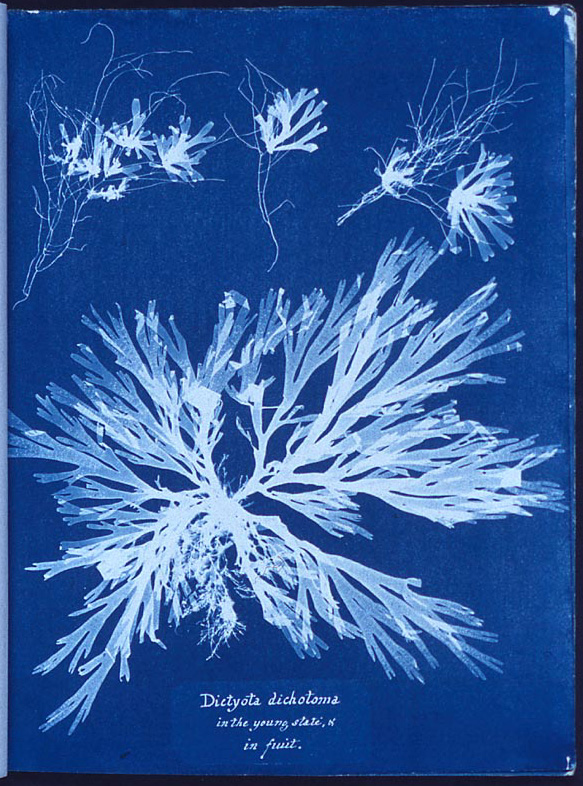
The process of creating a cyanotype was developed in the mid 1800s by John Herschel and is still in use by alternative photographers today. It’s a fairly straightforward process: treat paper or fabric with ferric ammonium citrate or ferric ammonium oxalate, and potassium ferricyanide; lay an object on said paper or fabric; place in the sun for a few minutes; develop with water. The first “illustrated” books—created by Anna Atkins, a friend of Herschel, and Anne Dixon—documented botanical (especially British algae) and textile specimens. Because Herschel never patented the cyanotype process, it’s always been accessible, and because the process is fairly straightforward (and modern chemicals are safe), this alternative and analogue method of photography is approachable.

During a session, up to 25 participants will meet to prepare the paper and create the cyanotype. Ahead of this session, there will be an optional opportunity to meet up at a park to collect nature samples (i.e. leaves, flowers, stones) for the cyanotype printing, and participants will leave with details on how to dry and press what they find. For the main session, folks will be invited to bring items they’d like to print (such as film negatives, lace, feathers, stones, sand, keys, etc) or natural materials (like leather or wood). Some pre-pressed nature samples, craft items, paper, and natural fabric will also be provided and purchased through this grant. At each session, we’ll have some discussion questions as we wander and gather or wait as chemicals dry and the exposures develop, respectively. Each participant will be given a card to take notes on and these cards will be collected at the end of each session.
Sample questions for the optional session: How can we collect ethically, non-extractively? What do we want to preserve? How does looking for samples change how we engage with nature? What kind of material are you looking for, what catches your eye? How does knowing your photo will eventually be the negative image of what you collect change what you look for?
Sample questions for the main session: What does it mean to preserve items or images in this way, using simple materials, the sun, and time? Is there any symbolism in this negative image, where the shadow is preserved? How does this process challenge how you think about the photographic image? Of time? Of light? What do you take away from this manual process?

I’ll use a scanner or digital camera to document the resulting cyanotypes and choice excepts from the notecards and create a zine that will only be shared with participants. It’s tempting to create a digital publication that could be distributed to the physical community and the world online, but I think that would subvert the entire project: the point is transience and ephemerality, the project forces us to be there in time and in the sun to create these stunning blue photographs. That preservation from the public eye is important, and yet I believe that folks will find it valuable to see their creations in conversation with their peers’ and their collective thoughts observations so I do want to create a little token, a small gallery, in addition to them leaving with their prints. This zine will be ideally created and distributed in the spring.
Leave a Reply